The Ship That Broke Its Builders
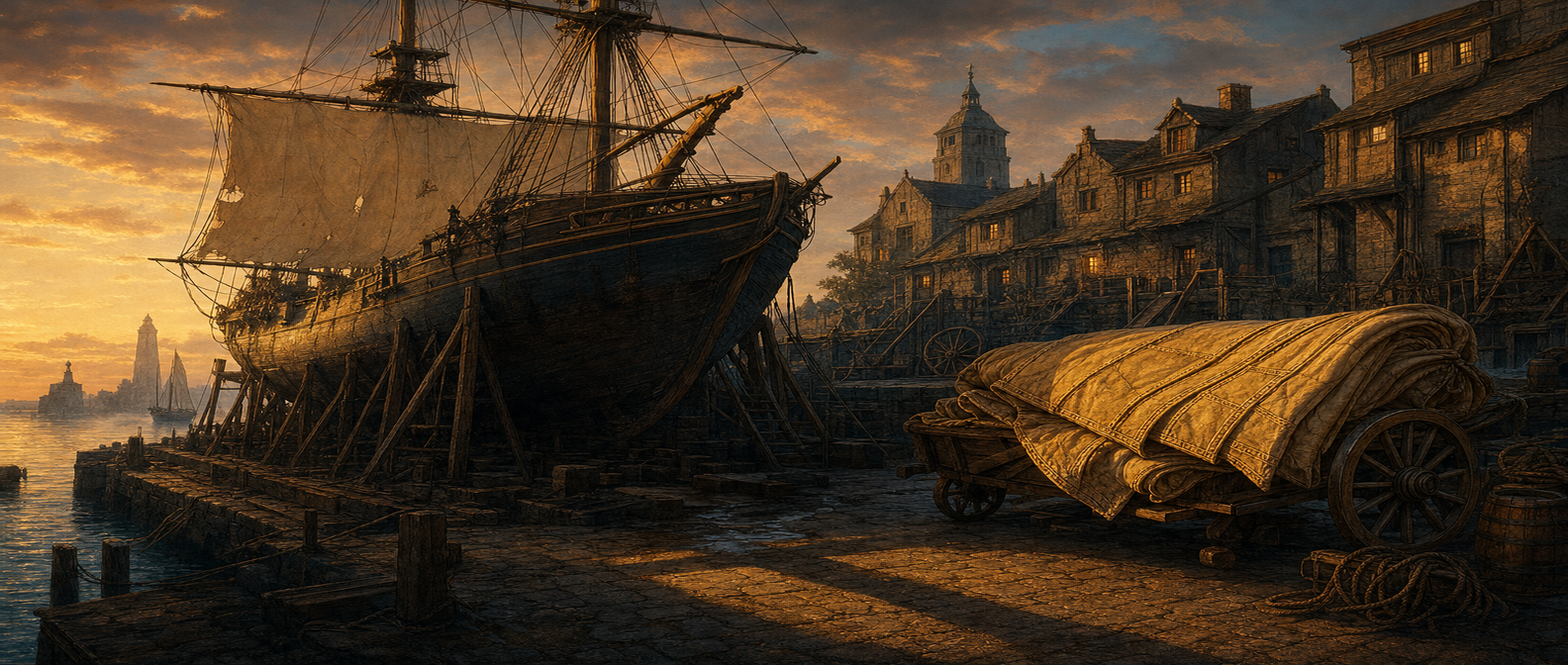
In the harbor town of Aldermoor, two master craftsmen had built fine vessels together for years. Corin the Shipwright shaped the hull and raised the masts — he answered for the whole ship. Elara the Sailmaker wove the sails — a single, specific art, but one no ship can sail without. They trusted each other completely, and together they were far better than either alone.
One spring, a wealthy Merchant commissioned a grand ship to lead the midsummer regatta — a hard, public date the whole coast would be watching. He needed both masters: Corin to build the ship, Elara to give it a great mainsail.
The Merchant went to Elara first. She was thrilled — but she could not finish the mainsail by the regatta. For good reason: she had begun a masterwork of triple-cured canvas, double-stitched at every seam, a sail built to hold through a decade of storms. Rushed, it would be ruined. So she told the Merchant plainly: “It cannot be hurried. It must be made properly.”
She meant: the great sail is coming, and it will be worth the wait. But she gave only the answer, not the reason. What the Merchant heard was a door closing.
So he went to Corin. “Elara won’t make the regatta,” he said. “You built the whole ship — can’t you just rig a sail so we can launch on time?” He never mentioned the masterwork on Elara’s loom, because he had never heard of it.
Corin, capable and eager to save the day, rigged a quick sail of plain, cheap canvas. It looked fine at the dock. On a bright, fair-weather morning the ship led the regatta home, and the town cheered its beauty. At the harbor feast, the Merchant praised Corin by name for delivering the winning ship. He never thought to mention Elara — in his mind, she had bowed out.
Days later, Elara arrived at the dock, her finished mainsail folded on the cart, ready to bend to the yard — and found a cheap sail already on the mast, and her partner of twenty years hailed as the man who built the ship that won. She did not hear “misunderstanding.” She heard theft. A friendship of two decades ended in an afternoon.
An old harbor pilot who had watched it all shook his head. “No one lied. No one was lazy. Each of you filled a silence with a reasonable guess, and every guess was wrong. Elara gave her answer but kept her reason. The Merchant carried only what he heard. Corin helped with only what he was told. And the one thing that broke was the one thing none of you were guarding.”
For the cheap sail split in the first autumn gale, as such things do. Only Elara’s canvas could have carried the ship through open water — but she would never rig it now, and no other hand wove like hers. The regatta was won, and the ship never sailed again.
Why this matters for Engineering
Nobody here lacked intent, skill, or care — they had all three in abundance. What failed was information symmetry. And the most dangerous gap is the unintentional one, where no one even knows a piece is missing. Everyone acted faithfully on what they could see, and what they could see was incomplete. Closing that gap — not working harder — is the actual job, and it takes both sides:
If you’re the one answering, give the whole sentence — not the verdict. “We can’t hit the date” is a verdict. “We can’t hit the date because we’re building the durable version that will serve this far better, and here is when it lands” is the whole sentence. The reason is the part that matters; an answer without its reason is where asymmetry is born.
If you’re the one listening, ask — don’t assume what you heard is all there is. The Merchant heard “no” and assumed refusal. Corin heard “rig a sail” and assumed no one else was making one. Neither asked the single question — “Why?” or “Is anyone already working on this?” — that would have revealed everything. When a decision rests on someone else’s context, assume you are missing a sentence, and go get it.
A met deadline can hide a broken foundation. Winning the regatta looked like success while the real asset was being destroyed. Always ask what the “win” borrowed against.
Credit is not cosmetic. Misplaced recognition turned good-faith help into perceived betrayal. The casualty was never the sail — it was the trust between two makers, the true engine of everything they had built.
The hardest failures in an organization are rarely caused by bad people; they are caused by the silent gaps between what each good person knows. Closing unintentional information asymmetry is everyone’s job — say the whole reason when you speak, ask the missing question when you listen. You can hack a component back into place. You cannot hack a partnership back together.