Taste vs. Skills
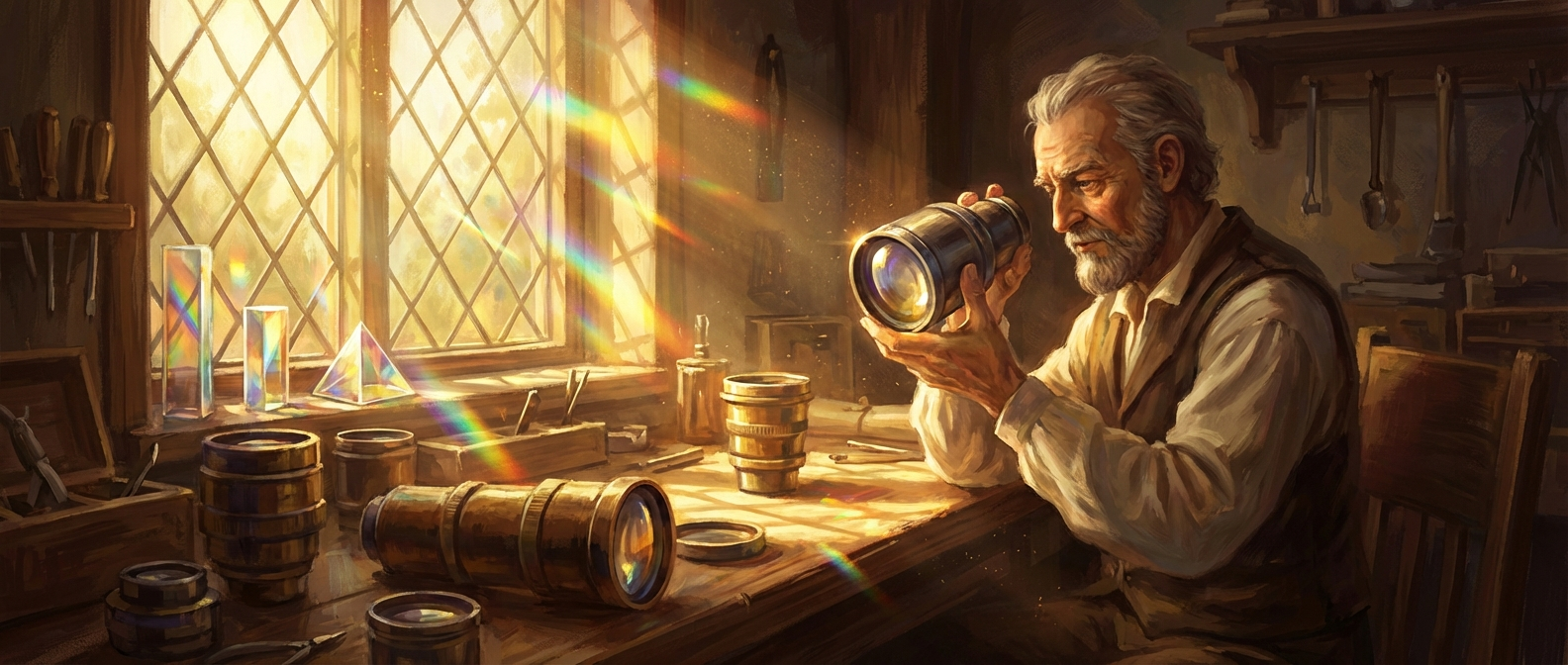
A profound discussion during PSC inspired me, so I decided to get Gemini’s help in coming up with another story.
The Master of the Blurred Glass
In a city famous for its telescopes, there was a young apprentice named Andy. Andy was eager to become the greatest lensmaker in the land. On his first day, he walked into the workshop of the Master and reached for the grinding tools. He wanted to feel the grit of the sand and the heat of the glass.
The Master stopped him. “You are not ready to touch the tools, Andy.”
“But Master,” Andy argued, “how can I learn to grind glass if I do not practice? I want to build the most powerful telescopes in the world.”
The Master didn’t answer. Instead, he handed Andy a small, finished lens. “Look through this,” he said. Andy looked. The world was slightly clearer, but there were tiny distortions at the edges.
“Is it good?” the Master asked. “It seems fine to me,” Andy replied.
The Master sighed. “That is why you cannot touch the tools. You do not yet know how to see what is wrong.”
The Months of Observation
For the next six months, the Master did not let Andy near the furnace. Instead, he forced Andy to spend every day in the “Hall of the Greats.” This hall contained the finest lenses ever made—some from a hundred years ago, some from the current masters of other kingdoms.
Andy was tasked with one job: Comparison. He had to look at the same star through ten different lenses and map the differences. At first, they all looked the same. But after a month, he started to notice a slight yellow tint in one. After three months, he noticed a microscopic “fuzz” in another. By the fifth month, he could tell the difference between a “good” lens and a “state-of-the-art” lens just by how the light hit the surface.
The Ceiling of Excellence
One day, the Master brought Andy the lens that Andy himself had thought was “perfect” on his first day. Andy looked through it and winced. “This is terrible,” Andy said. “The edges are warped, and the clarity is muddy.”
The Master smiled. “Six months ago, you would have been satisfied building a lens like this. If I had let you start grinding then, you would have spent all your energy training your hands to reach a ‘perfect’ standard that was actually a failure. Your Skill would have plateaued at the level of your ignorance.”
The Integration
Finally, Andy was allowed to pick up the tools. His hands were clumsy at first. He lacked the “Skill.” But because his “Taste” was now calibrated to the highest level, he was his own most brutal critic.
When he made a mistake, he didn’t need the Master to tell him; he could see the distortion immediately. Because he knew what the State of the Art looked like, he didn’t stop practicing when his work was “good enough” for the market. He only stopped when his work matched the “Taste” he had acquired in the Hall of the Greats.
Why This Matters for Engineering
In engineering, “Taste” is your internal compass. If you don’t develop it first, you will fall into these traps:
-
The Local Optimum Trap: You become the best at using a tool or a methodology that is actually outdated or inefficient, simply because you never looked at the “State of the Art” elsewhere.
-
The “Good Enough” Plateau: You stop improving your Skill once your code works. But “working” is the floor, not the ceiling. Taste tells you that “clean, maintainable, and elegant” is the true goal.
-
The Feedback Vacuum: Without Taste, you cannot benefit from a mentor’s feedback. You will see their corrections as “subjective opinions” rather than “objective elevations” of the craft.
When you enter a new domain, your first job is to expand your library of excellence. Read the best code, study the most resilient architectures, and understand why the ‘Masters’ made the choices they did. Do not pick up the hammer until you have seen the cathedral. If you train your skill before your taste, you are just learning how to build a better shack.